Sunday, September 23, 2007

AIM reaches the STARS! CONGRATULATONS!

Detroit HS tech stars get backers
Principal Patricia Pickett, Superintendant Connie Calloway, Rev. Jesse Jackson. PHOTO BY JACKIE BARBER

By Eric T. Campbell

The Michigan Citizen

DETROIT - Leaders from the education, faith-based and labor communities came together in front of the Northwestern High School student body Thurs., Sept. 14, to announce the creation of the Northwestern High School Success Project.

The assembly, held in Northwestern�s auditorium was part of the Rainbow/PUSH Third Annual Community Symposium.

Rev. Jesse Jackson, Deputy Mayor Anthony Adams, Detroit Schools Superintendent Connie Calloway and U.S. Representative John Conyers addressed the students.

The "Success Project" was initiated by a partnership of Northwestern Alumni with the Michigan Labor Constituency Council, the UAW, International Union, New Detroit Incorporated and the Rainbow/PUSH coalition.

Honorary Chairs and committee members include a long list of Detroit community leaders and activists. The five-year pilot program seeks to identify specific educational and structural needs at Northwestern and to raise a $500,000 fiduciary fund for the school to "augment their academic program over a five-year period", according to the symposium guide booklet.

The program also stresses the need for "community wide mobilization" to support student's scholastic needs and improve Detroit high school graduation rates.

"They've raised over $90,000 for us to augment our programs, organizations and clubs, to have a holistic approach, a community approach to transforming," Northwestern Principal Patricia Pickett told the Michigan Citizen. "We're going to try and develop a clean, safe learning environment with rigorous instruction. We're all stakeholders, continuously learning."

Northwestern High School was chosen to pilot the program in part because of its potential to incorporate an extended academic structure. The curriculum at Northwestern already includes nine advanced placement classes, four computer laboratories, two libraries and one of the only Planetariums located in a Michigan public school.

Dr. Shedrick Ward is the facilitator of the AIM program at Northwestern, which identifies and nurtures students from the ninth grade on and offers scholastic options based in technological fields.

"To bring the teachers together across areas to perform a unified approach" that's the American transformation of the high schools so that the kids are connected to places like Ford Motor Company, Chrysler, General Motors, who have their challenges in this global network," Dr. Ward told the Michigan Citizen in his office. "But young people still have some responsibility in understanding what that challenge is going to be when they leave high school."

In addition to the morning assembly, the Community Day Symposium also included a luncheon and town hall meeting, at which participants discussed and reviewed elements of the "Success Program".

The day ended with a black tie gala and fundraising dinner at the Charles H. Wright Museum of African American History. Keynote speaker Judge Greg Mathis has strong ties to the "Success Program" through his National Youth and Education Crusade, which focuses on issues of crime and education.

But the day was best exemplified by the gathering of the student body in the high school auditorium on Grand Boulevard, during which wisdom was passed from generation to generation in the spirit of community uplift and educational advancement.

"We are now the conscience of this country," congressman and Northwestern High graduate, John Conyers told the listeners. "We are now holding hands with the 6.6 billion people in the world and we can all make a difference."

Keynote speaker Rev. Jesse Jackson paid tribute to Northwestern High and its role, even beyond the neighborhood.

"You have such a sterling history and heritage of impacting our world by lessons taught and learned from this school," Jackson began.

He focused directly on the students in the building and their responsibility to uphold the advancements made by those in the Black community.

"We're going another way, against the odds, we at Northwestern, are going to higher ground," the audience repeated with Jackson. "We shall lift ourselves, and our community, our city, our state, by the power of our minds. We change our minds, and the whole world changes. We must first change our minds to change the world."

Friday, September 21, 2007

SWEET! (UWSEM Agenda for Change Initaitive)


September 7, 2007

United Way for Southeastern Michigan

1212 Griswold Street

Detroit, MI 48226

Ref: UWSEM Agenda for Change “Educational Preparedness” Collaborative LOI

Agenda for Change Committee:

Communities to Schools Regional Digital Collaboratory

SKETCH of INTENTION “Pilot Project”: Create and develop a youth-based digitally networked community (networked two-way telecommunications) of inclusive entities to include schools, neighborhood and city community centers, human service organizations, various community capacity building organizations, public service organizations, arts and cultural organizations, business, industry and government.

Attributes of Aspirations (Limited Only by Our Combined Imaginations, Creativity and Innovation)

  • Community Interaction and Engagement

*Build deeper and richer community alliances. Build organizational leadership and capacity, service-learning and engagement vehicles for change from merely synergistic to systemic imperatives.

  • Educational Enhancement and Distribution Channels

*Utilize existing K-12 educational assets; teachers, pedagogy, curriculum, underutilized digital infrastructure, etc. Develop digital media and learning curriculum, pedagogy, distribution methodologies and modalities aligned with new 21st Century economic realities with a particular focus on Science, Technology, Engineering and Math (STEM) disciplines. Create connections to relevant real-world experts and working environments.

  • Youth Development and Leadership

*Create student-led, student-taught, project-based explorations emphasizing creativity, innovation and entrepreneurial endeavors that resonate with their world as they encounter it while also learning how to think instead of what to think.

  • 21st Century Skills for New Creative Economy Career Development
*Utilize digital technological innovations as a foundational element to further our youth’s interest in connecting socially to the world around them while coaching and facilitating conventional understandings (problem solving, critical thinking, cognitive discipline, creativity, innovation, collaboration, social responsibility) of how our great society works thereby enhancing our local, regional, state, national and global competitiveness in the urgent “brute-force to brain-force” transformation.

Thursday, September 13, 2007

Something from which to "Frame" our Intentions

Some recent additions to OUR Portfolio

The Creation of Consious Culture through Educational Innovation
http://changethis.com/38.03.EdInnovation


The Mind of The Innovator
http://changethis.com/37.01.MindInnovator

Monday, September 10, 2007

Saturday, August 25, 2007

Importance: URGENT!

The Preschool Question: Who Gets to Go?

Va. Expansion Efforts Highlight Debate

By Maria Glod
Washington Post Staff Writer
Wednesday, August 22, 2007; A01

The children in Carrie Hamilton's preschool class yesterday drew wobbly hearts with wobbly letters underneath. They tapped the buttons on a toy cash register and raced cars over roads built of wooden tracks. Hidden in the games and giggles were lessons on the building blocks of reading and math.

These Fairfax County 4- and 5-year-olds are part of a national push to devote more public resources to the youngest learners. They are also at the center of a debate, underscored last week in a Virginia policy shift, over whether the government should offer preschool to all children or concentrate on those from poor families.

Nationwide, about 950,000 children are enrolled in state-funded preschool, a 36 percent increase from five years ago, said experts who track the programs. As advocates promote quality pre-kindergarten as a way to prepare children for school, strengthen the workforce and reduce crime, states have increased funding since 2005 for such programs by 75 percent, to $4.2 billion, according to the District-based organization Pre-K Now. Some in Congress have also proposed more federal money to help build state preschool initiatives.

The questions about which children will benefit most from government-funded preschool and how great the investment should be are at the core of Virginia's effort to expand pre-kindergarten but have also arisen in Maryland. Next week, in its first foray into all-day preschool, Montgomery County plans to introduce full-day, federally funded Head Start classes for 260 students at 10 elementary schools that serve low-income neighborhoods. This week, Prince George's County expanded its full-day state-funded preschool program by half, to 261 classes, also targeting students from poor families.

After campaigning in 2005 to offer free preschool to every 4-year-old in Virginia regardless of family income, Gov. Timothy M. Kaine (D) scaled back his plan last week and said he would focus resources on the neediest children.

In an interview yesterday, Kaine said his pledge to launch universal preschool was prompted by research showing that a tremendous amount of learning takes place before the first day of kindergarten. But education experts persuaded Kaine to build on the work of existing public and private preschools.

"Instead of just creating a system from scratch, why not take the existing network and focus on the goals of increasing access and increasing quality?" Kaine said. "We can change the financial criteria to help kids who can't afford it and have an impact on the quality of all parts of the system."

Virginia 4-year-olds who qualify for free school lunches -- those in households with incomes of less than $27,000 for a family of four -- are eligible for free preschool, and about 12,500 children take part at an annual state cost of about $50 million. Kaine's plan would extend benefits to children in families with incomes up to $38,000. The new proposal, which envisions enrolling about 17,000 more underprivileged children by 2012, would cost an additional $75 million a year.

Kaine also is calling for a state-led rating system to help parents gauge how providers measure up. Preschools, much like restaurants or hotels, would be rated on a five-star scale based on such factors as the educational level and training of teachers, class sizes and an expert's classroom observation.

Kaine's plan to offer universal preschool for all 100,000 4-year-olds in the state would have cost about $300 million annually.

Bruce Fuller, an education and public policy professor at the University of California at Berkeley who is a leading proponent of income-targeted funding, said research has shown that children from poor families get the biggest boost from high-quality preschool. He said universal preschool provides unneeded benefits to wealthy families and said the emphasis should be on helping children in lower-income homes, who tend to start school knowing fewer letters and numbers than their peers.

"We need to focus scarce dollars where the benefit is the greatest, and that's to children from low-income and blue-collar households," Fuller said. "If dollars are sprinkled across all families rich and poor, it's illogical to think early learning gaps will be narrowed."

But other education experts said the country should shift to preschool for all children. They say every dollar spent on public preschool will improve school performance, lessen the need for remedial education and have other long-term benefits.

A recent study of New Mexico's preschoolers showed that students in the state program learned many more words and scored higher on a test of early math skills than peers who didn't attend.

"Even though it costs more, the public is better off if they make sure it gets to all kids," said W. Steven Barnett, director of the National Institute for Early Education Research at Rutgers University. "Even middle-income kids, the middle 60 percent, have a 1 in 10 chance of failing a grade, a 1 in 10 chance of dropping out of high school. A lot of that can be traced to how far behind they were when they started kindergarten."

Libby Doggett, executive director of Pre-K Now, which backs universal access, applauded Kaine's proposal. "Given the political realities of the state, he's starting where he should," Doggett said, alluding to Virginia's budget constraints.

The federal Head Start program provides preschool for about 900,000 children from low-income homes across the country, and many states fund classes targeted largely to disadvantaged children. Georgia and Oklahoma offer universal preschool that reaches large percentages of children. Other states, including West Virginia and New York, are working toward such programs.

In Florida, voters approved a constitutional amendment in 2002 that mandates pre-kindergarten for all children, but critics contend the quality of the program has suffered because of a lack of funding. Last year, California voters rejected a ballot measure that would have taxed the wealthy to pay for universal preschool.

In the District, more than 5,000 children are enrolled in full-day preschool programs in public schools.

The nonprofit preschool of Annandale Christian Community for Action, where Hamilton's students played yesterday, is one of several private centers in a pilot program started by Kaine to help Virginia reach more children from disadvantaged homes. This summer, the center has new state funding for 26 additional children.

Camilla Torejo, 4, showed off her artwork as classmates flipped through books, played computer games and zoomed around with toy cars. "I made this heart and this heart and this heart," Camilla said. Next to them, she wrote her name.

Staff writer Daniel de Vise contributed to this report.

Wednesday, April 11, 2007

Detroit Neighborhood Fund Grant 2007


Grant Guidelines
http://www.cfsem.org/grants/special_grants/PDFs/CF_DetroitNeighborhoodsSingle.pdf

East Side Profile
http://www.cfsem.org/grants/special_grants/PDFs/near-eastside_profile_ppt.pdf


Posted: Wednesday, 04 April 2007 3:51PM

$$$ Earmarked for Detroit Neighborhoods


Detroit -- If you're with an organization or firm that has a good idea--some money could be coming your way.

Specifically, the idea has to create a positive link between existing and emerging neighborhoods on Detroit's near east side. If so, the Community Foundation of Southeast Michigan wants to hear about it.

Foundation president Mariam Noland tells WWJ's Pat Sweeting that $15 million is being made available through the Detroit Neighborhood Fund. "We're announcing the availability of funds for large, transformative projects, up to a million and a half dollars for projects and much smaller community engagement grants," said Noland.

Noland good ideas that have been brought up already include safe streets, transportation, and access to good food.

© MMVII WWJ Radio, All Rights Reserved.

Thursday, February 22, 2007

Tuesday, February 20, 2007

Thursday, December 28, 2006

Good Neighborhoods Grant Initiative 2006


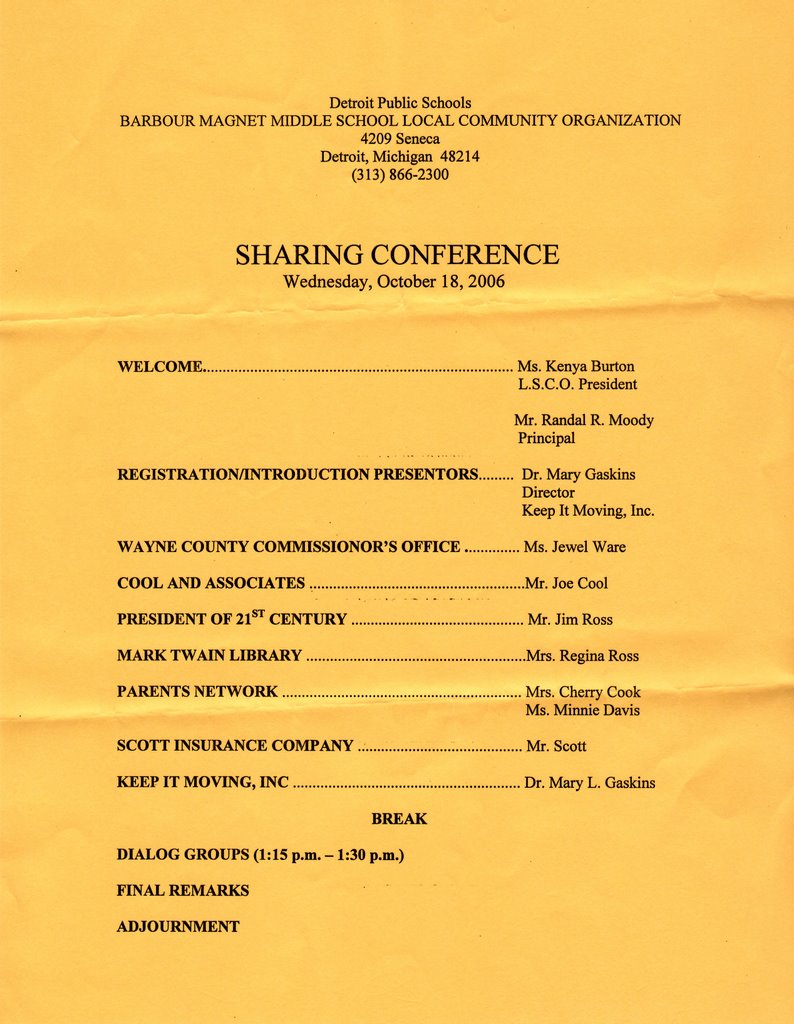
Dr. Mary Gaskins "Reading Corner"
GOOD NEIGHBORHOODS
Park Initiative 2006


Saturday, November 04, 2006

Building an Online Community / TENTPOLES of Origninating Intention

Submitted by: John Iras

Tips for Building an Online Community

By Susan Taylor
Nov 1, 2006
URL: http://www.techlearning.com/story/showArticle.jhtml?articleID=193401799

Attention school administrators: using technology to support virtual collaboration and establish an online community can serve as a useful tool to “keep the fire burning” among a planning group and help bring positive resolution to the task at hand.

The value of bringing the school community and various stakeholders together to address problems, find solutions and generally contribute to improving situations on the campus cannot be overstated. The most common way to bring people together is to host a face-to-face meeting. However, most issues are not resolved during a one-time meeting and follow up is usually required. In today’s world of competing priorities, it is difficult to find the space and time amenable to everyone’s schedule to allow for follow-up and ongoing conversations. To the rescue comes Virtual collaboration, and it can make a real difference.

Virtual Collaboration Tools

Virtual collaboration may be either Synchronous or Asynchronous. The difference: if it occurs during real-time activities like video teleconferencing or audio conference, where people are in different places participating at the same time, it is Synchronous; but if it enables participants to join in from different places at different times, then it is Asynchronous.

Some strategies to support virtual collaboration include the following:

Establish regular times for team interaction
Send agendas to participants beforehand
Designate a team librarian
Build and maintain a team archive
Use visual forms of communication where possible
Set formal rules for communication and/or technology use

Establishing an Online Community
To accommodate an online community, it is useful to think about the media being utilized and its effect on group dynamics. Kimball (1997, p. 3) provides some useful questions to help you with this process:

Media
Questions for Facilitator/Manager

Electronic Mail
What norms need to be established for things like: response time, whether or not Email can be forwarded to others?
What norms are important about who gets copied on Email messages and whether or not these are blind copies?
How does the style of Email messages influence how people feel about the team?

Decision Making Support Systems
How does the ability to contribute anonymous input affect the group?
How can you continue to test whether “consensus” as defined by computer processing of input is valid?

Audio (telephone) Conferencing
How can you help participants have a sense of who is “present?”
How can you sense when people have something to say so you can make sure that everyone has a chance to be heard?

Media
Questions for Facilitator/Manager

Video conferencing
How can you best manage the attention span of participants?
Where can video add something you can’t get with audio only?

Asynchronous Web-Conferencing
How do you deal with conflict when everyone is participating at different times?
What’s the virtual equivalent of eye contact?
What metaphors will help you help participants create the mental map they need to build a culture, which will support the team process?

Document Sharing
How can you balance the need to access and process large amounts of information with the goal of developing relationships and affective qualities like trust?

Building trust and establishing relationships is cited as a challenge for online communities, so begin with a face-to-face meeting and then pursue the online community. During your face-to-face meeting, let people know that you want to continue the conversations and ask people to join your online community by submitting their Email addresses to you.

To reach as many people as possible, keep things simple in the beginning. Initiate your online community with listserv messages. Begin by sending a message to your group thanking them for attending your recent meeting. One way to begin interaction is to post a question and ask people to respond.

Consider if you want responses to go out to everyone on the listserv or if you want all responses to come to you and you will compile the responses and send back to everyone. Compilation of responses may help ensure anonymity for your members and encourage participation in the beginning when the trust level may not be where it needs to be.

As your online community grows, it will be useful to host an audio conference or another face-to-face meeting to continue the work on building trust.

Remember to offer content and information focused on participants’ interests. Provide resources to help participants make informed decisions. Although information sharing does not encourage community interaction, it may serve to reinforce continue use of the online community.

Use opportunities to share success stories and reward or recognize members.

As your group becomes comfortable with the online community, you may want to consider providing more sophisticated methods to support and maintain your community. Of course, this will be determined by your members’ level of expertise and ability to meet the technology requirements.


Email: Susan Taylor


REFERENCES

Kimball, L. (1997). Intranet Decisions: Creating your organization’s internal network, Miles River Press.

Wednesday, October 04, 2006

DIGITAL Communities Connect!

Print Logos
Government Technology

Story Art

Digital Inclusion: Social Justice in a Communications Age

Sascha Meinrath
Sep 29, 2006
Story Art This is Part One of a 3-part series on Digital Inclusion perspectives from around the globe.

When do we recognize a shift in the fundamental social fabric of civilization? Where do we look to find better exemplars of participatory democracy? When do we realize that notions of justice have to expand to include a new ways of thinking about human rights? How do we change our institutions to support a more just and equitable world? These are the questions that thought leaders in the community and municipal wireless movement have been asking themselves more and more over the past few years.

An overarching theme that came up time and again during the interviews I conducted for this article is that we often think far too small when we talk about community networking. In a communications age, access to the resources, information, opportunities, and conversations that broadband services and community and municipal wireless networks facilitate is a vital element -- the foundation upon which the future of civil society rests.

The problem is to change the very nature of the municipal wireless debate -- incorporating a more liberatory language, more thoughtful actions, and the development and implementation of telecommunications infrastructures that directly improve the lives of users. At the heart of this debate is a tension between market economics and the "social contract" companies should be held to when providing critical resources to local communities. As Jim Baller, senior principal of the Baller Herbst Law Group, sums up, "digital inclusion is, or should be, a basic right of all Americans."

In citing the Declaration of Independence, Baller concludes that citizens have certain unalienable rights -- Life, Liberty and the pursuit of Happiness. "In the years and decades ahead, virtually everything that we do at work, in education, in public safety and homeland security, in medical care, in entertainment, in our communities, at the polls, etc., will depend increasingly on affordable access to advanced communications services and capabilities," states Baller. "No nation can lay claim to greatness without acting vigorously to ensure that none of its residents will be left out of the world."

What are the social and economic benefits of digital inclusion? Over the last few years, the importance of broadband services to communities has increased dramatically. Ben Scott, policy director for Free Press, puts it this way, "it is now beyond dispute that information and communications technologies bring advantages in education, job-training, social networking, health-care, and overall quality of life." However, accessing this critical resource is only one component of digital inclusion. As Scott relates, "Having the 'ICT trifecta' -- access to the Internet, the equipment to use it, and the skills to exploit it -- may well be the difference for many families between upward social mobility and a declining standard of living. For children especially, having access to technology is not a luxury, it is a social necessity."

The United States was founded on the notion of ubiquitous, equitable communications infrastructures. In fact, post-Independence, almost three-quarters of all federal employees worked for the Post Office. And the Post Office was built in response to the discriminatory policies prevalent at the time in the Royal Post of Great Britain. When Alexis de Tocqueville wrote "Democracy in America" in 1835, he praised the Postal Service and the newspapers and other information it conveyed as greatly responsible for the America's successes and the education of its populace. In discussing the Postal Service, de Tocqueville writes, "it is difficult to imagine the incredible rapidity with which thought circulates...It cannot be doubted that, in the United States, the instruction of the people powerfully contributes to the support of the democratic republic."

Paralleling this analysis, Jim Snider, senior research fellow at the New America Foundation, states, "Democracy requires well educated citizens. The Internet has become a necessary foundation for a well educated, economically productive citizenry for the 21st century."

John Atkinson, director of Wireless Ghana, concurs, positing that "communication and information give people hope and inspiration. You might say that communication access fosters social well-being, and that information access allows for economic potential." Dr. Arun Mehta, president of the Society for Telecommunications Empowerment, underscores the stakes for civil society, "you cannot have democratic processes that exclude a significant percentage of citizens."

The change in perspective that many wireless pioneers advocate is to look at digital inclusion as a vaccine that enhances civil society and protects against disruption. According to Harold Feld, Media Access Project's senior vice president, "leaving aside any considerations of social justice, creating permanently marginalized and technologically isolated pockets spread throughout our rural and urban areas is recipe for disaster. It imposes huge social and economic costs and creates a permanent underclass disconnected from the broader society."

And yet, leading broadband analyses support the notion that the United States has done a remarkably terrible job of connecting its citizenry over the past half-decade. Baller puts it thusly, "For the last six years, the Administration has defined America's best interests as synonymous with those of a handful of giant telephone and cable companies. During this period, trillions of dollars of investment capital have evaporated, America has plunged from 4th to 16th (some would say 19th) in global broadband penetration, and we have fallen increasingly behind the leading nations in access to high-bandwidth capacity and in cost per unit of bandwidth."

If we believe that civic participation is a central tenant of democratic society, then we need to think about Internet access as equally important. During the past half-decade, Matthew Rantanen, director of Southern California Tribal Technologies, has seen the impact of broadband services on Indian reservations he's worked with, "the people of this community have a better sense of control of their own destiny. They feel that by their own hand, they have taken control and have provided themselves with the opportunities that the majority of the rest of the country has access to."

Given the nature of broadband access, it is important to point out that the positive impacts of digital inclusion efforts do not accrue solely to those who are newly connected. As Mehta summarizes, "The value of a network goes up proportional to the square of its size." Like many "commons" (e.g., education, roads) everyone benefits as more people have access to the resource. Feld puts it this way, "The 'knowledge economy' really does benefit by having new people look at old problems in different ways or bring in wholly new considerations, ideas and tastes. In other words, digital inclusion is not about averting social catastrophe, or noblese oblige to the underprivileged, or charity. It is a calculated investment to promote our national self-interest, as sensible as any Silicon Valley VC investing in a start up."

With the class and knowledge divide growing in the United States, racism and xenophobia on the rise, and increasing concern about everything from the state of the Iraq war to woeful child poverty and healthcare coverage rates, why should we be concerning ourselves with municipal wireless? As Joshua Breitbart, principal at the Ethos Group, warns, "To the extent we digitize the public sphere, we exacerbate the racial and economic divides already prevalent in our society. It's the new Jim Crow. The Internet still offers the promise of a broader, more participatory democracy. Community wireless -- and not just civic projects, but networks with true community involvement and ownership -- is the vehicle for bringing people online and into the digitized public sphere."

Thus, when we talk about digital inclusion, it is important to think holistically about the potential impacts of this work. Michael Maranda, president of the Association for Community Networking has been forwarding what he calls "Digital Literacy, Access & Equity" for years. "Digital Inclusion is an aspect of social justice or equity," declares Maranda. "The Communications sector is both one of the most profitable and one of the most essential in the modern economy. The quality of the networks and infrastructure we have, along with the social and human capital investments in our communities, will define our quality of life and the direction our economies and societal structures will take."

This article is part of a three-part series on digital inclusion. Bellsouth declined comment for this series. Repeated e-mails and phone calls seeking comment were not returned by AT&T, Comcast, Earthlink, Insight, Qwest, and Verizon.

Friday, September 08, 2006

A Variation (and/or Validation) of OUR Theme!


Building the School of the Future

By Lindsay Oishi
URL: http://www.schoolcio.com/story/showArticle.jhtml?articleID=192501205

Microsoft and the School District of Philadelphia have worked together for three years to create the School of the Future, an innovative model for incorporating technology into education that opens on September 7, 2006. Rob Stevens, the project’s architect for software solutions, and Mary Cullinane, group manager for Microsoft’s Partners in Learning program, spoke to School CIO about how IT leaders can learn from the School of the Future’s vision and approach.

Q. How much has the school cost so far?
A. The entire project is funded at $63 million, which is a traditional budget for the School District of Philadelphi. The money required toa operate a school is mostly spent on maintenance. But we’ve used LEED (Leadership in Energy and Environmental Design) certification guidelines, so that the overall cost of maintenance will be less than the cost for schools that don’t follow these guidelines.

Q. What technologies are you providing students with?
A. Wherever these kids go, whenever there’s a learning opportunity, they have access to an infrastructure has been built to give them an appropriate environment. That means wireless throughout the school, experts from around the world coming in via streaming media, and infrastructure allowing them to communicate with teachers and parents. The collaborative environment will be very powerful. The other area that will be very powerful is the Virtual Teaching Assistant and Virtual Library. With these, we hope to foster a community of learning.

Q. Tell me more about the Virtual Teaching Assistant.
A. One of the principles of this school is to create an adaptive learning environment. When we went to school, every kid had to turn the page at the same time. With the Virtual Teaching Assistant, the class can have an individualized pace. As a teacher, you can put together a quiz, give it to your students, and immediately ascertain where your class is. The quiz comes up as a window on the students’ machines—they each have their own laptop computer. The results go back to the teacher right away, and if a student gets a certain pattern of questions wrong, the teacher can give them extra help in that area.

Q. How do you keep student data secure?
A. We’re relying entirely on credentialed access. Once you log into the operating system, we know who you are. You don’t have to remember multiple passwords. We have very secure passwords that allow, for example, parents to be identified only with their children, so parents will not be able to get information on another child. We’re not custodians of extremely sensitive information. But we do have the ability to protect it. It’s a well-bounded community of learners—people from the outside will have great difficulty getting information.

Q. Which technologies offer the highest return on investment?
A. First, the multimedia capabilities available through Windows Media services give students a wealth of resources that are visual and online. These are the most valuable in terms of the ultimate product, which is educational accomplishment. The Virtual Library, for example, is a repository for different types of digital media. It allows movies, documents, Web sites, and other content to be stored together. Second, we have automatic mechanisms for student enrollment. Whenever a student is added to the school, they automatically get a Windows account for school portals, e-mail, and a personal Web site. This translates into savings of time and administrative effort, which also reduces cost.

Q. How do school portals work?
A. The school has portals for students, the extended community, and faculty and staff. When you log in to your computer, you’re automatically logged in to your portal. If you’re a student, the portal knows what classes you have and shows you a picture of everyone in your classes. The extended community portals allow parents to be more familiar with their students’ teachers, and to find out what happened in the classroom. Faculty and staff can also use their private portal to communicate about students or even view pay stubs online.

Q. Do you have advice about making public-private partnerships work?
A. CIOs shouldn’t limit themselves to the most obvious asset a partner can bring to the table. When someone thinks about Microsoft, they think of software. But the School District of Philadelphia got to see how we hire people, motivate people, and create the culture of our organization. The other thing to remember is that money is great, but people are better. Individuals and their thinking are valuable resources. We’ve had over 45 people at Microsoft touch this project in various ways, and you can’t put a price tag on that.

Q. How can CIOs keep informed about the school?
A. Every step of the strategic planning has been documented on the Web site, for all schools that are interested in following a similar process. U.S. Partners in Learning will host quarterly briefings with schools across the country, and there is also an annual global forum where school leaders can get together and discuss the results of these innovations.

Lindsay Oishi is a graduate student in Learning Sciences and Technology Design at Stanford University.

© School CIO

Tuesday, August 29, 2006

Rigor, Relevance and Relationships ON HOLD?

Detroit Free Press Home | Back

DETROIT SCHOOLS SHOWDOWN: Teachers on strike

BY CHASTITY PRATT and KIM NORRIS
FREE PRESS STAFF WRITERS

August 28, 2006

photo

Where the sides disagree

The school year for Detroit students is supposed to start Sept. 5, a week from Tuesday. Under Michigan law, a strike by teachers is illegal, but the union and the school district remain far apart on key contract proposals.


Length of Contract


Teachers want a three-year contract. The district is proposing two years.


Wages


Teachers seek 5% raises in each contract year. The district proposes a freeze on increases and a 5.5% pay cut across the board.


Health care


The district wants teachers to pay 10% or 20% of their health insurance premium, depending on their hiring date. Currently, teachers hired after 1992 pay 10%; those hired before then pay 0%. Co-payments for prescription drugs would increase from $3 to $10 on generic drugs and from $15 to $20 on brand-name medications.


the district ALSO wants:


  • To eliminate one preparation period per week from kindergartens through middle schools.
  • To eliminate bonuses for critical-shortage hiring, attendance and longevity.
  • To cut wages, sick days and health benefits for long-term substitutes.

    The teachers also want:


  • A 25-minute shorter day in high school.
  • Time off to go to a doctor for head lice or ringworm and not have the time charged to their sick-day account.
  • Students who threaten or assault teachers to be transferred and the right to appeal readmission of a transferred student.
  • How districts compare

    Here's a snapshot of pay and other conditions at a range of metro Detroit school districts.


    ARMADA


  • Average elementary class size:
  • The target class size for kindergarten to first grade is 20 students per class and 25 students for second to fifth grades.


  • No. of teachers:
  • 175


  • Top teacher pay:
  • $68,031


  • Total reported crimes:
  • 70


    BIRMINGHAM


  • Average elementary class size:
  • 22


  • No. of teachers:
  • 612


  • Top teacher pay:
  • $82,131


  • Total reported crimes:
  • 3


    BLOOMFIELD HILLS


  • Average elementary class size:
  • Not available, though the district has a target of 22 students for kindergarten to second grade and 25 students for third to fifth grades.


  • No. of teachers:
  • 502


  • Top teacher pay
  • : $83,721


  • Total reported crimes:
  • 175


    DETROIT


  • Average elementary class size:
  • About 30


  • No. of teachers:
  • 7,000


  • Top teacher pay:
  • $72,918
  • Total reported crimes:
  • 5,574


    FARMINGTON


  • Average elementary class size:
  • About 24


  • No. of teachers:
  • 903


  • Top teacher pay:
  • $83,417


  • Total reported crimes:
  • 94


    GROSSE POINTE


  • Average elementary class size:
  • About 24


  • No. of teachers:
  • 585


  • Top teacher pay:
  • $83,768


  • Total reported crimes:
  • 77


    MT. CLEMENS


  • Average elementary class size:
  • Target is 19 in kindergarten through third grade, and 25 per class in fourth to sixth grades.


  • Number of teachers:
  • 175


  • Top teacher pay:
  • $69,430, based on the 2005-06 school year


  • Total reported crimes:
  • 84


    PONTIAC


  • Average elementary class size:
  • Maximum is 28 for kindergarten to third-grade classes; 34 for fourth- and fifth-grade classes.


  • No. of teachers:
  • 513


  • Top teacher pay:
  • $73,561


  • Total reported crimes:
  • 157


    SOUTHFIELD


  • Average elementary class size:
  • Maximum is 22 for kindergarten; 24 for first to third grades; 27 for fifth and sixth grades.


  • No. of teachers:
  • 700


  • Top teacher pay:
  • District is still negotiating a contract. In 2005-06, it was $80,766.
  • Total reported crimes:
  • 23


    Note: Total number of teachers still isn't locked in for many districts for the upcoming school year, as many are still hiring.


    Top pay refers to a top-of-the-scale teacher with a master's degree. Figures provided by school districts.


    Crime statistics come from the state Center for Educational Performance and Information and reflect reports from the 2004-05 school year for such offenses as robberies, bomb threats, physical violence, sexual assault, gang activity, vandalism and having weapons on school grounds.


    The Detroit Federation of Teachers voted Sunday against a two-year contract proposal that included pay and benefit cuts and agreed to a strike that will put teachers on the picket lines in front of schools starting today.

    Many teachers said they would accept a pay freeze, but considering the amount of crime in schools and bureaucratic mismanagement they say they put up with, they would not entertain the 5.5% pay cut the school district proposed. The union wants a three-year contract with 5% pay increases each year.

    Ronald Duncan, a Cooley High School teacher, stood in support of a strike, clapping. One of his hands was in a cast he says is the result of an incident where a student body-slammed him, tearing the ligaments in his right arm.

    "We make a big sacrifice. I can't tell you how much we spend buying supplies, and they want us to take a cut? It's not fair," he said. "In fact, I say it should be illegal."

    The teachers were due back to work today, but the union and district are far apart. The two sides have a week to come to an agreement before school starts for the district's 129,000 students on Sept. 5.

    Contract negotiations are to resume at 1 p.m. today.

    The school district, fearing the strike, plans to petition for a court order today to force the teachers back to work and fine those who strike.

    Superintendent William F. Coleman III said that if teachers do strike, parents should send their children as planned for the first day of school.

    Administrators, support staff and security will be on hand to accept students, he said, adding that the district does not have enough administrators to replace the 7,000 teachers.

    He maintained that the district needs $88 million in concessions from the union. "A strike does not change our financial situation," he said.

    School board president Jimmy Womack criticized the union, saying the strike would hurt the city and hurt schools. Most Detroit teachers do not send their own children because 60% of the teachers do not live in the city.

    "They need to take their concessions like everyone else. They need to participate in this revolution to try to bring this district back in line," Womack said, referring to the district's $105-million projected budget deficit.

    "And from my perspective, they're clearly a part of the problem and not of the solution right now," he said of the union.

    Of the estimated 6,000 DFT members who met at Cobo Arena for the vote, only a handful stood up in the auditorium to support the idea of returning to work while negotiators continued to craft a new contract.

    Detroiter Tom Wilson, a teacher in the district since 1997, most recently at McMichael Technological Academy, was one of the few who wanted to return to work today.

    "Parents have been hearing the 'S' word and are sending their kids to charter schools and out of the district. If I'm a working parent, I can't take a chance there won't be school to send my kids to," he said.

    His concerns were echoed by some parents, who worried not only about their own children, but the long-term future of the Detroit Public Schools, too.

    "I think it's going to devastate the district because people will leave," said Mia Parker, who has children in three Detroit schools.

    Janna Garrison, president of the DFT, never uttered the word "strike," but made it clear to the union that laws prohibit a work stoppage.

    "Just because it's a law, doesn't make it right," she added. "We believe we are fighting for what's right."

    Under Michigan law, teachers could be fined a day's pay for each full or partial day they do not report to work. The union could be fined up to $5,000 a day.

    By many accounts, Detroit teachers have it tough when compared with their suburban counterparts.

    Most spend their days in crowded classrooms in school buildings that are an average of 65 years old and deteriorating. They are routinely victimized by car thieves and, last year, by armed robbers, too.

    Add to that the public perception that the education they provide often does not measure up, and many teachers say it's a thankless work environment where even office equipment isn't available.

    "I want to be able to make copies when I need them. That's embarrassing to have to put that in the contract," said Theresa Williams, who will teach second grade this year at Murphy Elementary/Middle School.

    Kia Hagens, 31, of Detroit taught on-and-off in the district for about eight years between getting a master's degree and a law degree. She went to teach in Farmington Public Schools after DPS laid her off in 2005. Her pay jumped $7,000 and she has the potential to earn a top pay of $83,417 in Farmington compared with $72,918 in Detroit.

    She still remembers the day when a mouse jumped out of her cupboard in her sixth-grade class at Golightly Education Center.

    "In Detroit, they do not take care of business. You never know if you're going to be paid on time or not. And they do not treat their teachers well. I would tell any teacher on the fifth step or below, 'Run! You deserve better,' " she said, referring to the salary scale.

    In addition to a pay cut, the district wants teachers to pay up to 20% of their health care benefits premiums.

    A Kaiser Foundation survey found that nationally, the average worker with single coverage contributes $558 to his or her annual premium.

    Not so with many teachers.

    School employee benefits are better than the health benefit plans for 90% of other workers, said Adam Reese, senior consultant for HayGroup, a Virginia-based company that completed a study of school employee benefits for the Michigan Legislative Council last year.

    "Teachers have traditionally been provided with fairly rich benefits to ensure that their focus is on delivering care and education to students, not worrying about, 'I can't afford to go to the dentist or the doctor,' " Reese said.

    Shaton Berry said the current economy is not going to help the teachers gain support from the community when so many parents are losing their jobs. She has custody of two brothers in the district.

    "I pay $120 a pay period for health insurance plus dental and vision, so I don't have any sympathy when you're talking about health care," she said. "In the end, the students are the ones being hurt here. And if students leave, teachers are going to lose their jobs."

    Detroit's teachers on Sunday were not amenable to cutting their pay or benefits.

    Steve Conn, a math teacher at Cass Technical High who is credited with instigating the vote that led to a strike in 1999, also riled up the crowd with an emotional speech Sunday, chanting, "No contract, no work!" after which DFT member Michelle Gibson asked Garrison to call for the vote.

    Contact CHASTITY PRATT at 313-223-4537 or cpratt@freepress.com.

    Copyright © 2006 Detroit Free Press Inc.

    Friday, August 25, 2006

    Community Development Partner Succeeds!

    Detroit Free Press Home | Back

    Once-failing Detroit school makes the grade

    It also will have to improve next year to avoid sanctions

    BY CHASTITY PRATT and LORI HIGGINS
    FREE PRESS EDUCATION WRITERS

    August 25, 2006

    For years, Barbour Magnet Middle School on Detroit's east side was the catch-all building that took in busloads of students from overcrowded schools or those whose schools were closed for good.

    It did not meet the federal guidelines for annual yearly progress and was considered failing by the government for six years.

    Until June, the building was on schedule to be restructured under the federal No Child Left Behind Act.

    The staff and students were preparing to be split up and sent to other schools, having been branded a bad school.

    "I know that I put forth all the effort I could. I wanted for these children what I wanted for my own," said Randal Moody, the principal at Barbour for nearly 20 years.

    But the staff learned something in June that became official Thursday -- for the first time in years, it had met its Annual Yearly Progress standards and no longer faces restructuring.

    Moody said the secret to meeting the standards was in the planning.

    He mandated that his teachers meet twice a week to go over state curriculum standards and expectations alongside the district's guidelines to make sure every class is on target. Students were signed up for after-school tutoring and enrolled in a two-week summer MEAP academy.

    "Our focus was almost laser-like," Moody said.

    Barbour is one of 92 schools in various phases of federal sanctions that made AYP for the first year. If these schools make AYP again next year, they will be removed from the sanctions list.

    Some schools improved their status simply by getting more students to take the MEAP test, since federal law requires that schools test 95% of their students to meet the standards.

    But in some cases, schools improved because they worked hard, said Sharif Shakrani, codirector of the Education Policy Center at Michigan State University.

    Many of these schools didn't meet the academic goals because too few of their subpopulations of students -- including minorities, low-income students, special education students and those with limited English speaking skills -- scored well enough on the MEAP.

    "What they most likely have done is attempted to emphasize instruction to these populations, especially in the area of mathematics, which seems to be a problem for these schools," Shakrani said.

    But these schools can't rest easy now that they've managed to meet standards this year.

    Last year, none of the three high schools in Plymouth-Canton Community Schools met the standards because of low scores among special education students. This year, those three schools made it off the list. Most of the students took the MEAP, while some took an alternate exam designed for special education students.

    "The students worked very, very hard throughout the year. Obviously, when it came to the testing, they tried their very best," said Mike Bender, director of secondary education.

    "This is something we have to do," Moody said. "If we don't, based on No Child Left Behind, we're going to suffer the consequences."

    Contact CHASTITY PRATT at 313-223-4537 or cpratt@freepress.com.

    Copyright © 2006 Detroit Free Press Inc.

    Friday, May 12, 2006

    Detroit Free Press / Letters to the Editors Speaks Volumes

    Letters to the editor

    FROM OUR READERS: Detroiters, clean up your city

    May 12, 2006

    I have to admit I am amazed that someone needs to be appointed to clean up Detroit ("Dear Mr. Penske: Clean this first. Readers weigh in: Every corner of Detroit could use some attention," May 10). I don't get to Detroit often, but when I do I am always amazed at the litter embedded in the chain-link fences, broken glass on sidewalks and other junk.
    I am also amazed at the efforts to get people who don't live in Detroit to clean up the place. If you want to clean up Detroit, Detroiters need to clean their yards. To the many people who keep their homes immaculate, take a garbage bag to the nearest intersection, clean up the junk and put it out for pick-up.

    You don't need Roger Penske, you don't need Dave Bing, and you don't need me to clean up Detroit. All you need is some elbow grease.

    Randy St. Laurent
    Lapeer

    Get inmates to help out

    We could have had Detroit cleaned up long ago if people on welfare and non-dangerous prisoners were used to clean the streets, remove graffiti, etc., as a way to pay back society.

    We have a huge, untapped workforce receiving money for 26 weeks or three hots and a cot for the duration of their sentences, paid for by taxes. It's not too much to ask for a little elbow grease in return.

    Pauline Costianes
    Canton

    Focus on the neighborhoods

    What wonderful news to hear that millions will be spent on spiffying up Detroit's downtown. The sustainable value reaped from the millions spent on the Super Bowl fell short of expectations, so why not do more of what does not work? Entertainment and sports venues are important, but they should not be the primary consideration.

    Until we put equal resources into more complex needs of the neighborhoods, it is futile to think we have any future as a city.

    Mary Therese Lemanek
    Allen Park

    Change may be under way

    In response to your article on cleaning up Detroit, I would like to compliment Roger Penske on his fine efforts and the work he has done in Detroit. His leadership with the Super Bowl should be praised not just for showing the world a cleaner Detroit, but also for starting a revolution. After seeing what Detroit could be like with a little bit of effort, more people are taking action to clean it up. Penske started what could be the transformation of Detroit from a trash-covered place, to a cleaner, safer and better city.

    Nathan Yu
    Troy

    Penske is the man for the job

    I read with great interest your May 9 article, "Super Bowl czar to help clean up Detroit," and must say I'm extremely glad to see that Roger Penske has chosen to stick his flag, his stake, right here in the city of Detroit. Penske did a remarkable job with putting together Super Bowl XL and cleaning up downtown Detroit. I have no doubt that downtown Detroit will look like a scintillating star with him at the helm.

    Thomas A. Wilson Jr.
    Detroit

    Let's also have clean water, air

    Just one word for Roger Penske's decision to put his energy and reputation behind keeping downtown Detroit clean: Bravo! His investment should be a catalyst not just for clean streets and sidewalks, but for healthier air and water to make downtown and its neighborhoods great places to live and work.

    David Howell
    Chairman
    Friends of the Detroit River

    Lana Pollack
    President
    Michigan Environmental Council

    A waste of resources

    As someone who has worked cleanups in the city before, I can tell you it is a waste of time, money and effort when you are confronted by residents sitting on their porches, saying it is about time someone cleaned up as you pick up trash at their lawn and curb. Residents need to care about their own property and city before anything will change.

    Mark Levis
    St. Clair

    Take personal responsibility

    While I am excited about Roger Penske's involvement with the city, I can't help but think of the cliché "putting perfume on a pig." Too many of my fellow residents are thoughtless pigs, constantly leaving their trash for others to clean up.

    This conduct is condoned by others who step around the trash because "it's not mine." Until there is personal responsibility, Detroit will have more than its share of sties.

    Lee W. Astrauckas
    Detroit